
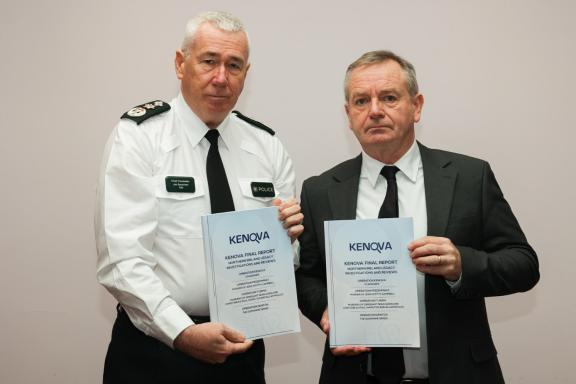
The Police Service of Northern Ireland has today, Tuesday 9th December, published the Operation Kenova Final Report.
Chief Constable Jon Boutcher said: “Today we are publishing the Operation Kenova final report outlining the work of the Kenova Team since it was established in June 2016.
“I would like to personally thank the Officer in Overall Command, Sir Iain Livingstone, and the rest of the Kenova Team for the thorough and professional investigation they have conducted.
“I stated in the interim report that the identity of the Army agent Stakeknife would have to be confirmed at some stage and made clear that this would benefit and not harm the public interest. As explained in the final report, the identity of Stakeknife still cannot be confirmed and the full story of his operation still cannot be told, more than 30 years after he stopped providing intelligence.
“This outcome was imposed on Kenova by the Government for no good reason and I know it will be a great disappointment to the families affected and cause them further pain and suffering.
“The report deals with MI5’s late discovery and disclosure to Operation Kenova of a significant quantity of relevant material relating to the handling of Stakeknife. This was provided after the Kenova prosecution decisions had been taken and the interim report published, and long after MI5 had said that all relevant material held had been made available.
“The fact this material was provided so late and at a point when further investigation was impossible only caused further upset to the families who have already waited many years to find out what happened to their loved ones.
“I remain concerned that where matters relating to Northern Ireland’s legacy are involved, there continues to be an unhelpful, unnecessary and protectionist approach to the disclosure of official records. This results in wild conspiracy theories and inaccurate reporting.
“During the Troubles, the security forces acted with immense bravery and endured huge sacrifices and this should never be forgotten. I have huge regard for what they endured and the sacrifices so many made with their lives.
“However, post the conflict we must challenge practices that prevent information about Troubles-related cases being released for no good reason. This has a huge and detrimental impact in the confidence of our citizens towards policing and Government.
“This final report again outlines the challenges faced in conducting legacy investigations but it also highlights that, no matter how difficult such investigations can be, they must remain victim-focused and keep the needs of the families who have lost loved ones to the fore.
“For this reason, I remain very deeply concerned about the lack of legacy funding for PSNI to be able to properly and effectively deal with legacy cases so as to ensure families are provided with the information they deserve.
“I am also frustrated by the Government’s failure to support our efforts to address the disproportionate and totemic approach to the way the ‘Neither Confirm Nor Deny’ or NCND policy - on the identification of state agents - is applied to Troubles-related cases, preventing families from receiving information that, both morally and legally, they are entitled to.
“The Kenova final report makes a compelling case for reforming the application of NCND. It sets out that absolute secrecy cannot be guaranteed for agents who commit serious crimes and that those who do should not be protected at the expense of justice, accountability and public confidence.
“The implications of NCND are profound. Its blanket application and the failure to depart from it in exceptional cases such as Stakeknife: denies victims and families the truth and thereby perpetuates their suffering; fuels conspiracy theories; hinders investigations and prosecutions; undermines trust in policing, the criminal justice process and the state; and allows wrongdoers to escape justice and the security forces to evade accountability.
“As quoted in the report: ‘Security agencies argue that to step away from NCND will put agents’ lives at risk, prevent recruitment and retention of those agents. Yet it is those agencies that in these cases failed to protect agents who risked their lives for the state. That irony should not be lost on anyone’.
“The Kenova investigations found that, in many cases, vital intelligence was withheld from investigators and families, not because of genuine security concerns, but because of a culture of secrecy.
“To be clear, my firm view is that the identification of Stakeknife would not put anyone at risk, affect the recruitment or retention of agents or the flow of secret intelligence or damage national security. I believe the Government’s claims to the contrary are untenable and bordering on farce.
“The Government’s refusal to allow Kenova to confirm the identity of Stakeknife serves neither the interests of justice nor the public interest. In moving forward, the following principles should guide the application of NCND and the broader approach to legacy investigations:
- NCND should be applied only where genuinely necessary, and not as a default or to avoid scrutiny.
- The presumption should be in favour of openness, with secrecy justified only on clear, evidence-based grounds. As public authorities we must be accountable for our actions, including the handling of agents and the investigation of serious crimes.
- The needs and rights of victims and families must be central to all policy decisions and the lessons of the past must inform ongoing reform, to ensure that mistakes are not repeated and public trust is rebuilt.
“In the future, we must ensure that our approach to legacy investigations is guided by the principles of openness, accountability, and respect for the rights of victims and families.
“As the Chief Constable of the Police Service of Northern Ireland, I am determined that all information relating to Troubles related cases will be disclosed to the new Legacy Commission established to investigate them regardless of its classification or sensitivity.
“I wish to thank all those who contributed to the report and again especially commend the bravery, resilience and humility of the victims and their families.”
---------------
Operation Kenova Final Report: Key Facts Relating to Stakeknife
* Stakeknife was recruited as an Army agent in the late 1970s and operated as such for over a decade into the 1990s (§9.22).
* Throughout this period, Stakeknife met his handlers on average once every seven or eight days (§9.32).
* The RUC Special Branch and MI5 knew of Stakeknife’s recruitment and identity from the outset and were supplied with his intelligence throughout, including reports disclosing his involvement in the abduction and interrogation of suspected agents who were then murdered by the IRA (§§9.23 and 12.19-12.20).
* The further material disclosed late by MI5 in 2025 covered almost the entirety of the period of Stakeknife’s operation (§4.5).
* During an 18 month period at the start of his career as an agent, Stakeknife produced at least 377 intelligence reports (§9.43) and a total of 3,517 intelligence reports attributed to him were ultimately recovered by Kenova (§9.43).
* Further, in the period between the conclusion of the Stevens Inquiry in the early 2000s and the commencement of Operation Kenova in 2016, MOD destroyed original documents relating to Stakeknife including, for example, two files of “contact forms” which recorded meetings with his handlers (§9.41).
* At different points, both the RUC Special Branch and MI5 offered or sought to take over the running of Stakeknife from the Army (§12.20(5)).
* Following the recruitment of Stakeknife, the Army established a dedicated sub-unit known as “the Rat Hole” specifically to deal with his handling and intelligence (§9.26).
* MI5 had a member of staff permanently located within “the Rat Hole” (§§9.26 and 12.20(2)).
* A bespoke database known as “Bog Rat 3970” and “Osbourne” was established to process Stakeknife’s intelligence, but no trace of it remains (§9.28).
* A number of Stakeknife’s Army handlers went on to work for MI5, including as the Assistant Secretary Political and Deputy Assistant Secretary Political supporting the Director and Coordinator of Intelligence - MI5’s main representative in Northern Ireland and principal security adviser to the Northern Ireland Secretary (§§12.22-12.24).
* MI5 was involved in tasking Stakeknife through his military handlers and it received debriefs on all his intelligence and was involved in discussions about his role, importance and use and, furthermore, it also supported his operation through the provision of specialist technical support (§12.20(2)-(3)).
* Stakeknife’s Army handlers routinely massaged his ego, for example, telling him that if he stopped reporting “the loss would be felt throughout the intelligence world” (§9.35).
* The Army also: paid Stakeknife tens of thousands of pounds and helped him purchase a property (§9.35); discussed ways he could obscure the ownership of his assets so as to protect them against potential future legal claims (§9.53); and discussed the provision of a five or six figure sum to cover a pension or salary (§9.56).
* For a period towards the end of the 1980s, the Army temporarily stopped sharing Stakeknife’s intelligence with the RUC because it suspected that the RUC had used it to identify someone suspected of murdering a police officer and that this could have compromised Stakeknife’s identity (§9.45).
* Early attempts to resettle Stakeknife were unsuccessful (§§9.54-9.55) and he was eventually resettled in Great Britain in the mid-2000s in a detached property and with a car (§§9.56-9.57).
* Stakeknife’s Army handlers flew him out of Northern Ireland on military aircraft for holidays on two occasions when they knew he was wanted by the RUC for conspiracy to murder and false imprisonment (§§9.60 and 12.28).
* Kenova prosecution files named Stakeknife as a suspect in connection with more than two dozen offences including allegations of conspiracy to murder, conspiracy to unlawfully imprison, conspiracy to kidnap, false imprisonment, unlawful wounding, grievous bodily harm and unlawful possession of firearms (§§11.2 and 11.4).