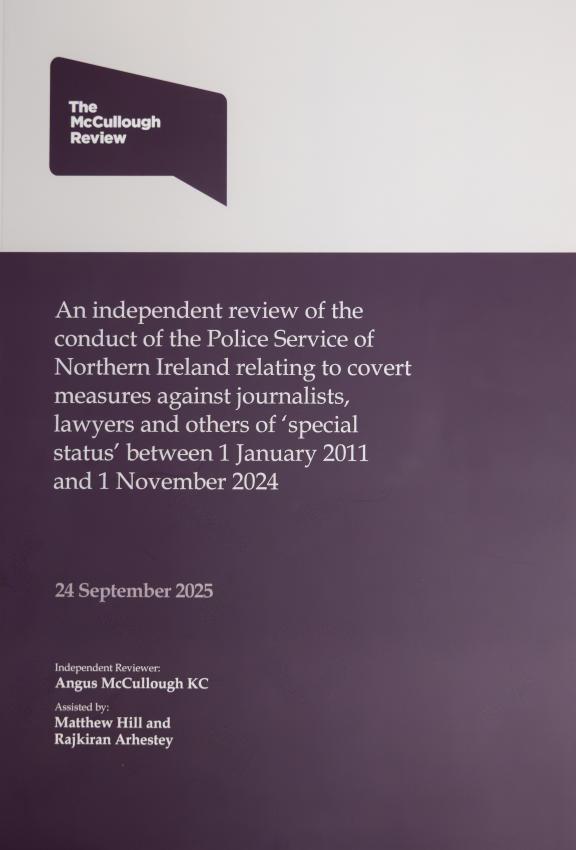
The Police Service of Northern Ireland has today, Wednesday 24 September, published the McCullough Review. Commenting on the publication of the Report, Chief Constable Jon Boutcher said: “In June 2024 I appointed Mr Angus McCullough KC to conduct an independent review of PSNI’s use of surveillance against journalists, lawyers and other groups defined within his terms of reference, during a period from 2011 to 2024.
“The wider concerns of a perceived systemic abuse of our use of covert powers originally arose from an investigation led by Durham Constabulary, in which two journalists, Trevor Birney and Barry McCaffrey were arrested and had their property searched in August 2018. It subsequently became clear in the course of legal proceedings that warrants issued for the searches and for other surveillance activity were unlawfully obtained. I apologised for those mistakes and actions.
“I gave a commitment that the Review would be given unrestricted and unsupervised access to all police systems and records and would receive the full support and cooperation of all officers and staff. I would draw the attention of everyone to the comments made by Mr McCullough that he experienced an open and forthcoming approach from all officers and staff and had unfettered access to PSNI systems. This has been a thorough and comprehensive piece of work that has recommended a number of improvements to ensure we conduct surveillance with proper consideration to those people from a special category status.
“It is important to say that applications for communications data, the major focus of this report, is whereby the metadata of the telephone numbers involved in a call are provided to the police, that communications data does not provide policing with any information of what was said or communicated. It simply tells the police what telephone numbers are contacting each other, but not what people are actually communicating.
“Properly exercised covert powers have an important role to play in the detecting, investigating, prosecution and prevention of the most serious crimes. Mr McCullough makes reference to being struck by the utility of these powers in keeping the public better protected from a range of threats including organised crime, terrorism, paedophile rings and large scale drug supply. This underscores the pressing need for such powers and the enormous, if unseen, benefit from them being properly exercised. Appropriate, lawful and proportionate use of these powers helps keep everyone in Northern Ireland safe and builds confidence in policing.
“The report does not identify any issues of misconduct by individual officers. What it does identify is individual authorisations where we as a police service could have done better and I am committed to ensuring we do in the future.
“In June 2024 we published a report and included details of 323 applications relating to journalists, however, Mr McCullough’s Review has identified 378 applications. The two factors which contributed to the differing numbers: one is the different approaches to how systems were searched and relevant applications identified; and the second is that Mr McCullough’s Review covered a slightly longer period of time, approximately six months longer than the June 2024 report.
“I have met with a number of key stakeholders to explain the contents of the report, including Sir Brian Leveson from the Investigatory Powers Commission, Lady Chief Justice, Dame Siobhan Keegan, Attorney General, Dame Brenda King, members of the Northern Ireland Policing Board, the First and deputy First Minister and the Justice Minister.
“We have informed the Information Commissioner’s Office relating to data protection compliance and the Investigatory Powers Commissioner’s Office of direct surveillance applications as they were not previously informed of involving those attracting special status.
“Mr McCullough has written to the individuals directly affected and I have also written to each of them.
“The Review identified concerns in relation to some specific authorisations, inconsistencies in processes and record keeping, but must be seen in the context of more than 110,000 authorisations within the review period.
“I am pleased to learn that the Review has found no basis for concerns that PSNI surveillance of journalists or lawyers is widespread or systemic. The Review rightfully highlights that we have to improve our processes, and we will.
“I am aware of commentary calling for a Public Inquiry into these matters but this report shows that no such inquiry is necessary. As part of the Review, Mr McCullough has provided information intended to assist with more accurate media reporting and to help with ‘myth-busting’. In his report, Mr McCullough has identified a combination of factors which have had a compounding or ‘snowballing’ effect that has given rise to concerns about the PSNI. His Review helpfully corrects this misrepresentation of the position.
“I am conscious that with such a detailed report there will be a natural tendency for some readers to focus only on where we got things wrong. I have been reassured by Mr McCullough’s comments about the ‘far more numerous examples of careful and considered practice’ processed by conscientious professionals ‘in full accordance with the applicable legal framework and its safeguards’. I hope the Policing Board and the public will be reassured notwithstanding that we have to tighten up our processes.
“Properly exercised covert powers have an important role to play in the detecting, investigating, prosecution and prevention of the most serious crimes. Mr McCullough makes reference to being struck by the utility of these powers in keeping the public better protected from a range of threats including organised crime, terrorism, paedophile rings and large scale drug supply. This underscores the pressing need for such powers and the enormous, if unseen, benefit from them being properly exercised.
“I see the McCullough Review as being akin to a health check that has highlighted a need for improvements and, organisationally, I can absolutely stipulate that we will make those improvements. We will implement the recommendations of the Review and adhere to safeguards and considerations for those with a special category status. We want to be the best across policing.
“I would like to thank Mr McCullough and his team for the detailed and professional Review that has been undertaken."