
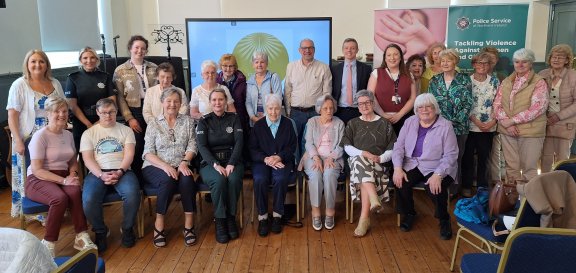
Police from Derry City & Strabane joined statutory and community organisations in St. Eugene’s Cathedral Parish Hall on Thursday, 30 April, for an event to raise awareness of stalking.
Stalking is a pattern of unwanted, repeated behaviour which can leave you feeling scared or distressed. You do not have to be threatened with violence to be a victim of stalking, and any kind of persistent, unwanted contact which causes distress is stalking.
Sometimes stalking behaviours can appear small in isolation, but when they are combined into a pattern which follows the FOUR mnemonic - Fixated, Obsessed, Unwanted, Repeated - then you should record it, keep a log of evidence and report it before it escalates further.
Thursday's event featured speakers from the Police Service of Northern Ireland (PSNI), Foyle Women’s Aid, and the Foyle Women’s Information Network (FWIN). Attendees heard from each organisation, with informative and impactful inputs about how to recognise stalking behaviours, understanding the law in Northern Ireland, and accessing vital support services.
Attendees heard how stalking is defined in law, including the use of Stalking Protection Orders, and the role of police in identifying patterns of behaviour that often form part of wider coercive control and domestic abuse.
Partner organisations provided insight into the lived realities of victims, highlighting the emotional, psychological, and practical impact stalking can have, as well as the importance of early intervention and reporting.
The event created a safe and supportive environment for open discussion, with participants engaging in conversations around personal safety, recognising warning signs, and understanding the pathways available for help and support.
Frontline organisations also shared information on advocacy services, safety planning, and ongoing support for those affected.
This collaborative approach between policing and community partners demonstrates a continued commitment to tackling violence against women and girls, increasing awareness of stalking, and strengthening community confidence in seeking support.
The event formed part of ongoing efforts to educate and empower local communities, ensuring that stalking is recognised, reported, and addressed effectively.
A Police Service spokesperson said: "Stalking is a crime, which will not be tolerated or accepted within our communities.
"Thousands of our officers and staff have now been trained to recognise and respond to these crimes and we will continue to use every tool at our disposal to bring offenders to justice."
For further advice about spotting the signs of stalking and how to report it and seek support, visit https://www.psni.police.uk/safety-and-support/keeping-safe/protecting-yourself/stalking-and-harassment
In an emergency, always call 999.
If you are not sure if you are being stalked you can contact the National Stalking Helpline: https://www.suzylamplugh.org/pages/category/national-stalking-helpline or 0808 802 0300.
Spotting the signs (a non-exhaustive list):
Getting unexpected visits to your home or place of work
Having persistent phone calls, messages or contact over social media
Receiving unwanted gifts or items turning up at your address
Interfering or damaging someone's property, or breaking into their home
Hanging around somewhere you know the person visits
The stalker making contact with your family, friends and colleagues to gain information about you, or make complaints
Verbal abuse and/or public humiliation
Hacking into social media or your emails
Spreading rumours/discrediting
Threats made against the person, family, friends and pets
Blackmail
Seeking physical proximity by applying for jobs where the victim works; joining the same gym; church; professional/social sports groups or clubs; moving into the same neighbourhood or building
Identity theft - pretending to be the victim
Running up debt in the victim's name
Planting spyware - viruses on the victim's computer/laptop
Tracking location