
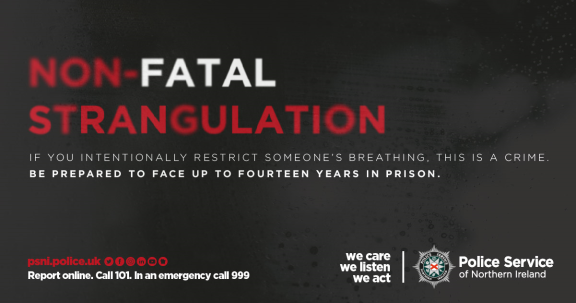
This month marks two years of the non-fatal strangulation or asphyxiation being made a specific criminal offence in Northern Ireland, punishable by up to 14 years’ imprisonment.
Before this legislation, investigating police officers would have to provide evidence of intent to commit an indictable offence. For example, if someone had been strangled in what was believed to be a sexually motivated attack, the officer would have to show that the perpetrator intended to commit sexual assault before they could pursue prosecution.
This new legislation means that if you do anything that does or could restrict someone’s breathing in any way you should be prepared to face a prison sentence for this offence alone. Non-fatal strangulation includes; any part of your body or another object such as a ligature like a scarf or belt, chokeholds or headlocks, hanging, drowning or smothering.
Strangulation and suffocation can also at times, leave no visible injury, making it previously even more difficult to prosecute.
Over the last two years 26 June 2023 to 31 May 2025, there were 1,893 non-fatal strangulation reports recorded by the Police Service of Northern Ireland. In this time officers investigating have made 1,755 arrests resulting in 765 charges.
Detective Superintendent Lindsay Fisher explains: “Our figures show that between 10-12% of reporting domestic abuse victims have experienced non-fatal strangulation, placing them at the highest risk. In fact, studies have shown that in domestic abuse settings, victims are eight times more likely to be murdered by their partner if they have previously strangled them.
“We have made a significant amount of arrests and hit the ground running with this new legislation in just the first two years. Over 2,000 officers have received specific training. We hope that this gives victims the confidence to come forward and continue reporting knowing that our officers are recognising and responding to the seriousness of this violent act.”
Sarah (not her real name) has been a victim of non-fatal strangulation twice at the hands of her abusive ex-partner, she reported to Police and as a result the perpetrator pled guilty to both incidents, she says: “I remember the first time it happened, I couldn’t quite believe that this violent man had my life in his hands. Although the strangling only lasted a matter of seconds it felt longer to me. You almost exit your body and feel everything slipping away as you struggle to breathe and lose control of your bladder. It is the most terrifying thing I’ve ever experienced.
“Feeling another person’s hand on your throat and looking into their eyes as they squeeze is surreal. I am pleased that the police have hit the ground running with this legislation over the last couple of years and helped women like me get justice. To be listened to, believed and supported is all someone needs who has been through what I have.
“In any abusive relationship the victim always feels guilt about the burden the trauma places on others around them, I am no different. Phoning the police that night as I sat broken on the top of my stairs, was the best thing I ever did for me and my children. I have created distance between me and my abuser and we are finally safe. My message to others out there is – don’t risk your life by staying.”
Detective Superintendent Lindsay Fisher added: “It is common for strangulation to leave no visible signs of injury and consequences can be delayed by days or weeks. These include stroke, cardiac arrest, miscarriage, incontinence, seizures, memory loss and long-term brain injury.
“Consciousness can be lost after as little as four seconds. Blocking the jugular vein can take less pressure than opening a can of coke. Loss of consciousness indicates at the very least, a mild brain injury and many victims lose control of their bladder and bowels.
“Often strangulation is glorified as a gratifying act for both parties in pornography and young people in particular are susceptible to thinking this could be a fun, ‘consensual’ act to spice things up. However, the reality is far from the case. Consent to rough sex is not a defence.”
The Police Service of Northern Ireland have explained this new legislation and the dangers of non-fatal strangulation on their website here: www.psni.police.uk/non-fatal-strangulation
If you have been the victim of non-fatal strangulation - report to the Police via 101 or call 999 in an emergency.